How can we help?
Pick a lane, take the guided tour of every screen, or scroll for the everything-Q&A and the full metric glossary.
Run your first verdict in minutes: first 3 deals free, no card.
How it works →The methodology + Questions library: what we research, how grading works.
Read the methodology →What a credit buys, deep runs, auto recharge, cancel anytime.
See pricing →Analyze deals from inside Claude. Setup takes 2 minutes.
Set up the connector →What ATD is (decision support) and isn't (financial advice).
Read the disclaimer →Bugs, wrong facts, missing answers: real replies.
Contact us →The guided tour: every screen, one by one
Real captures from the product (sample data). What each surface is for, in order.
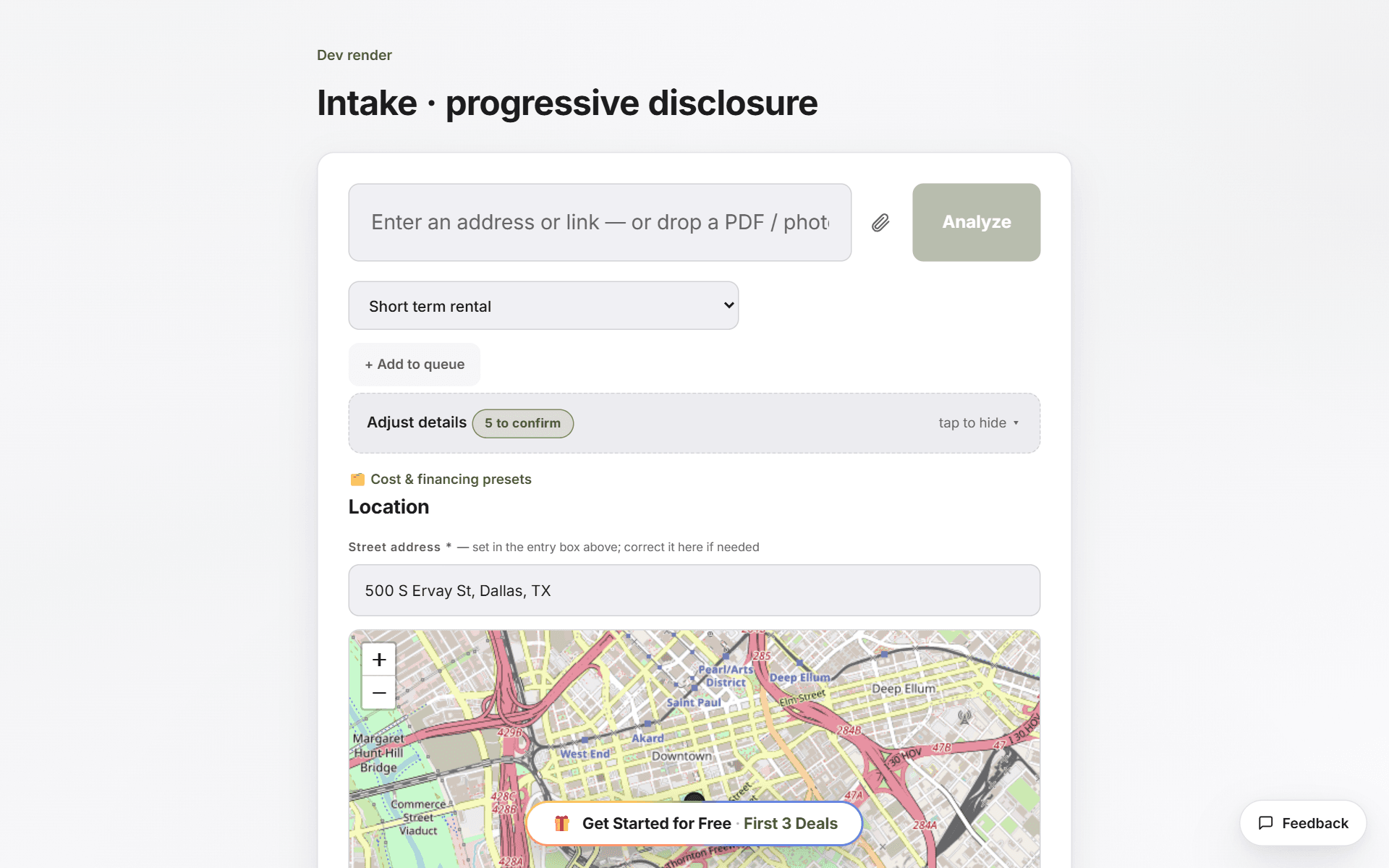
Enter the address, pick your strategy (STR, long term, Section 8, BRRRR, flip, wholesale, subject to, or buy to live), and add the basics. Drop a listing link or PDF and the assistant prefills what it can. The button tells you exactly what's missing before anything runs.
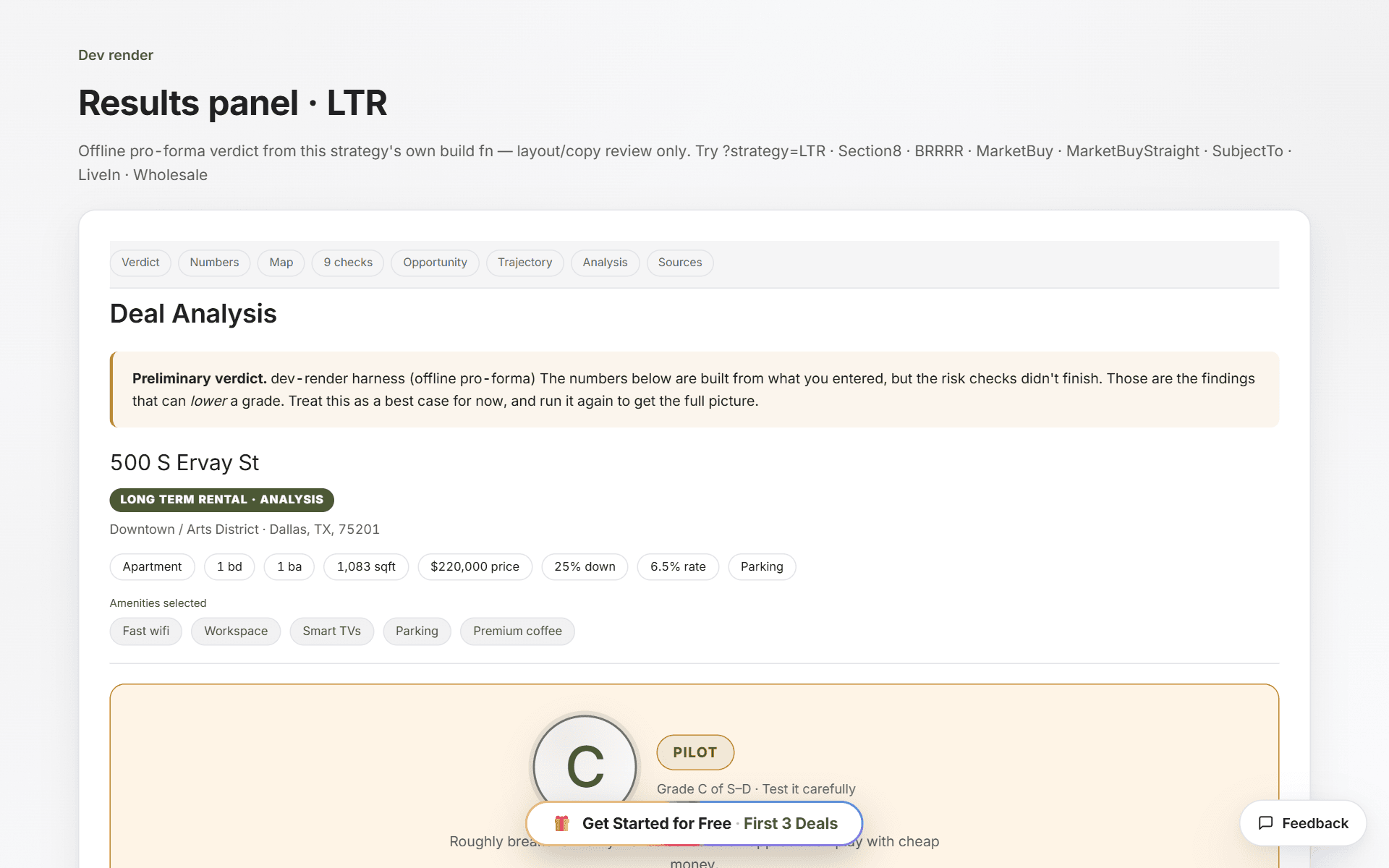
The grade medallion (S to D) with a plain verb verdict (ACQUIRE, PILOT, or PASS), a blurb in your strategy's own language, and the horizon line telling you what the grade is measured on (a 3 to 6 month project reads nothing like a 10 year home).
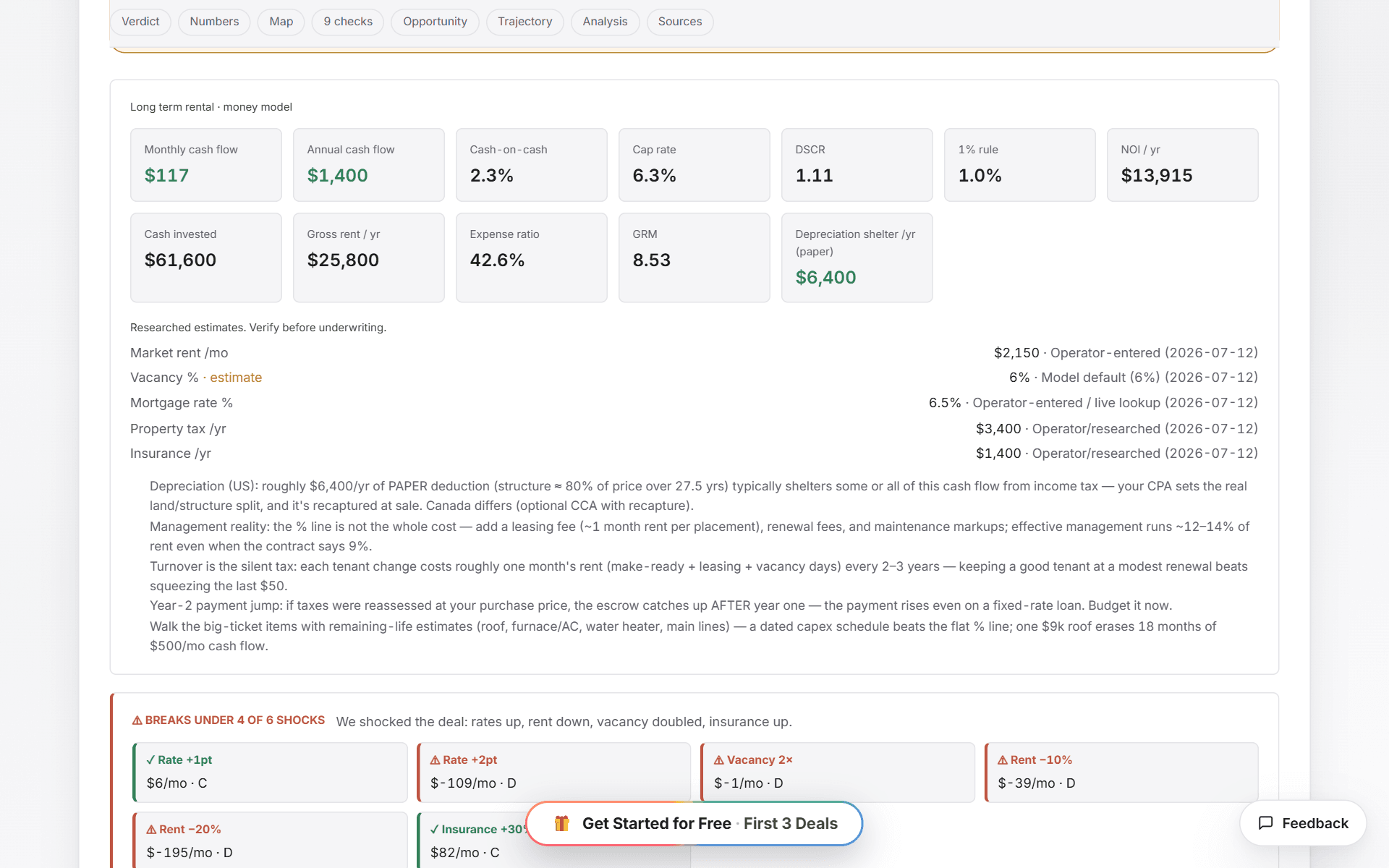
Every number the grade rests on, in your strategy's units. Below it, the researched inputs table showing where each figure came from and when. Estimates and fallbacks are labeled; nothing is disguised.
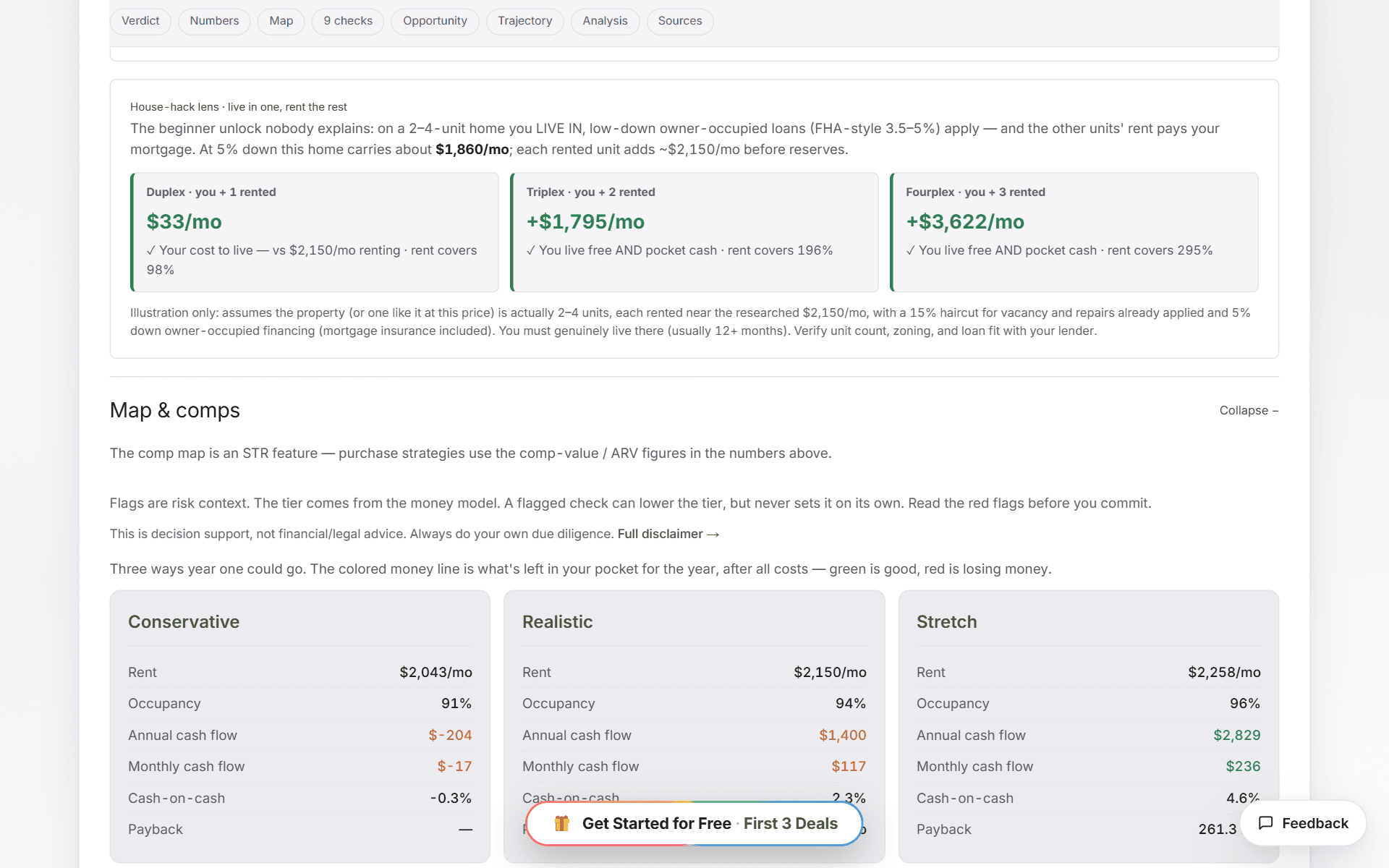
The premortem. We shock the deal (rates up, rent down, vacancy doubled, sale price cut, renovation over budget) and show which shocks it survives (green) and which flip it (red), plus the exact breaking points.
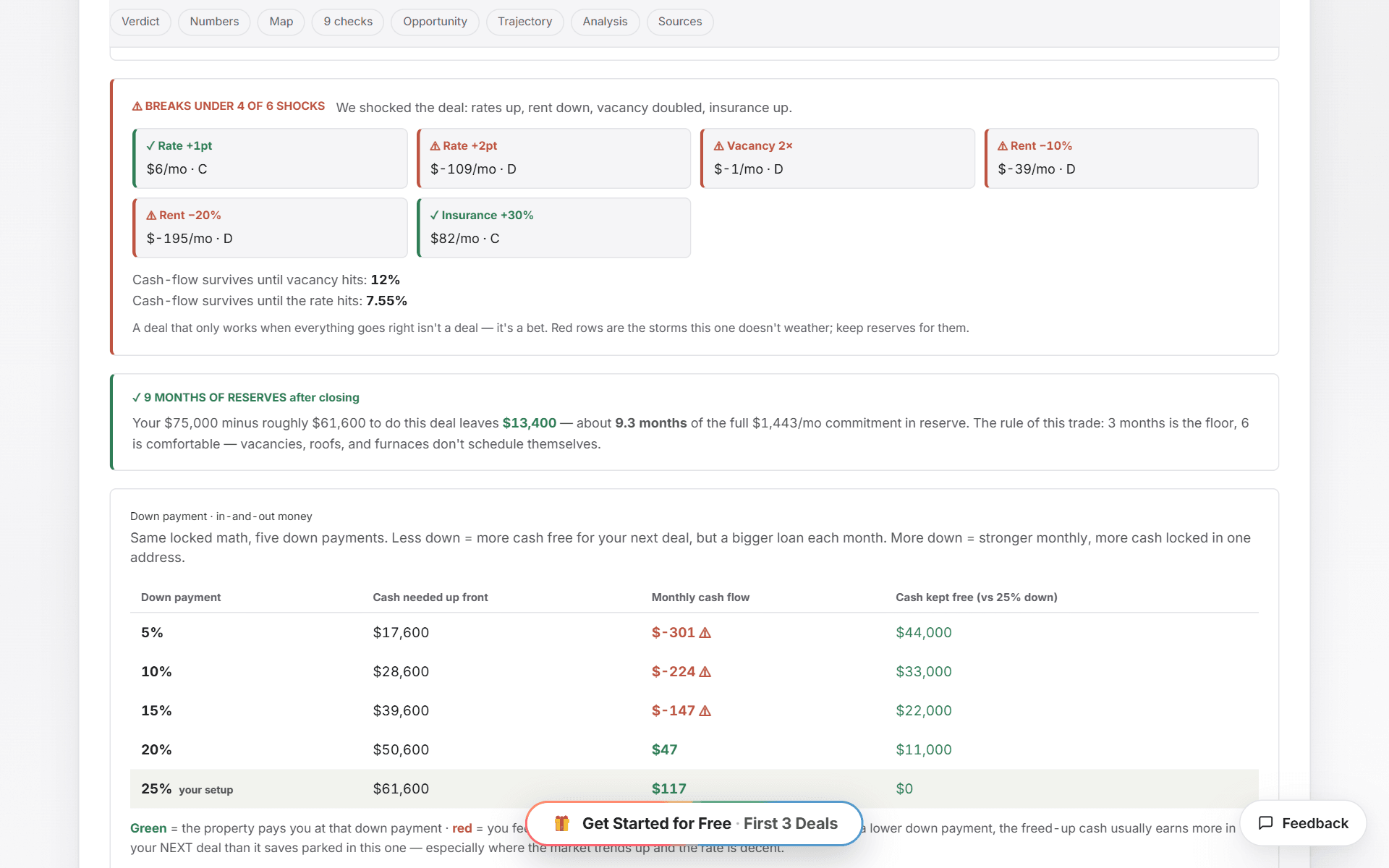
Tell us your cash on hand and the verdict answers the question nobody asks until the furnace dies: after closing, how many months of the full payment do you have left? Green at 6+, amber at 3 to 6, red below. And it says plainly when you can't close at all.
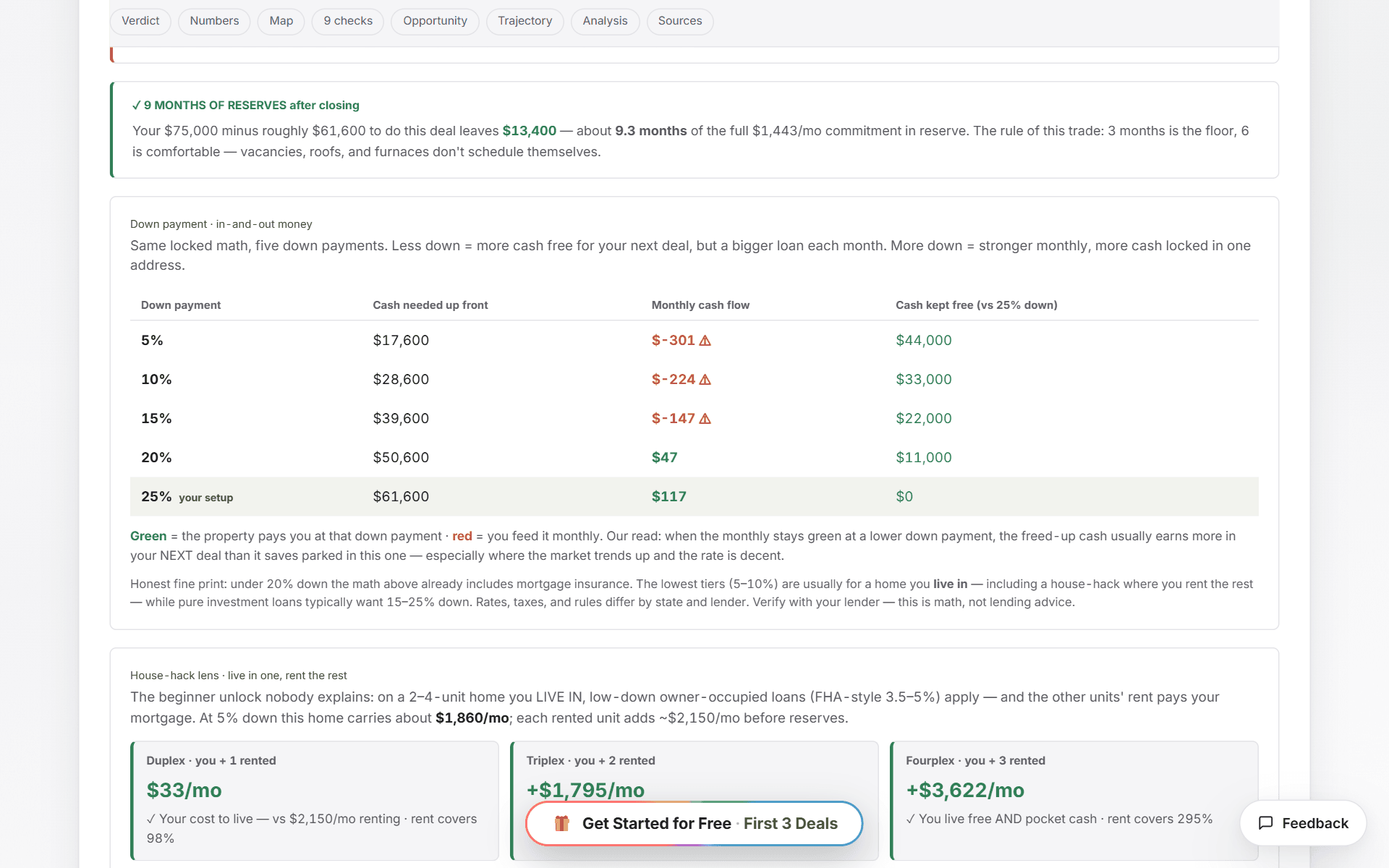
The same locked math at 5/10/15/20/25% down: cash needed up front, monthly cash flow at each tier (green = pays you, red = you feed it), and the cash kept free for your NEXT deal. Canada aware: rental minimums and the stress test rate are flagged for Canadian addresses.
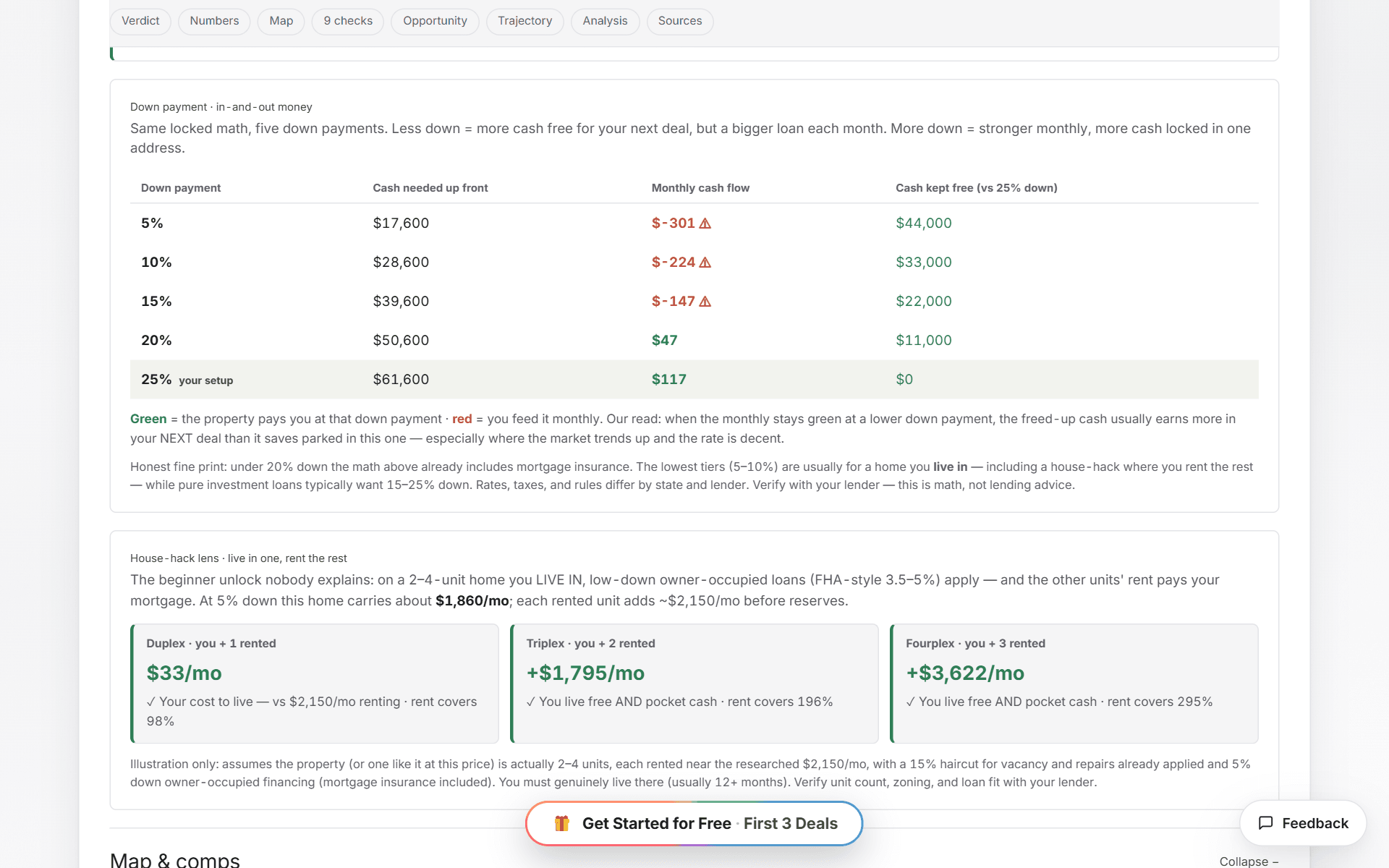
Live in one unit, rent the rest: at ~5% down owner occupied, duplex/triplex/fourplex cards show your true monthly cost, down to "you live free AND pocket cash", with the reserves haircut already applied and honest fine print.
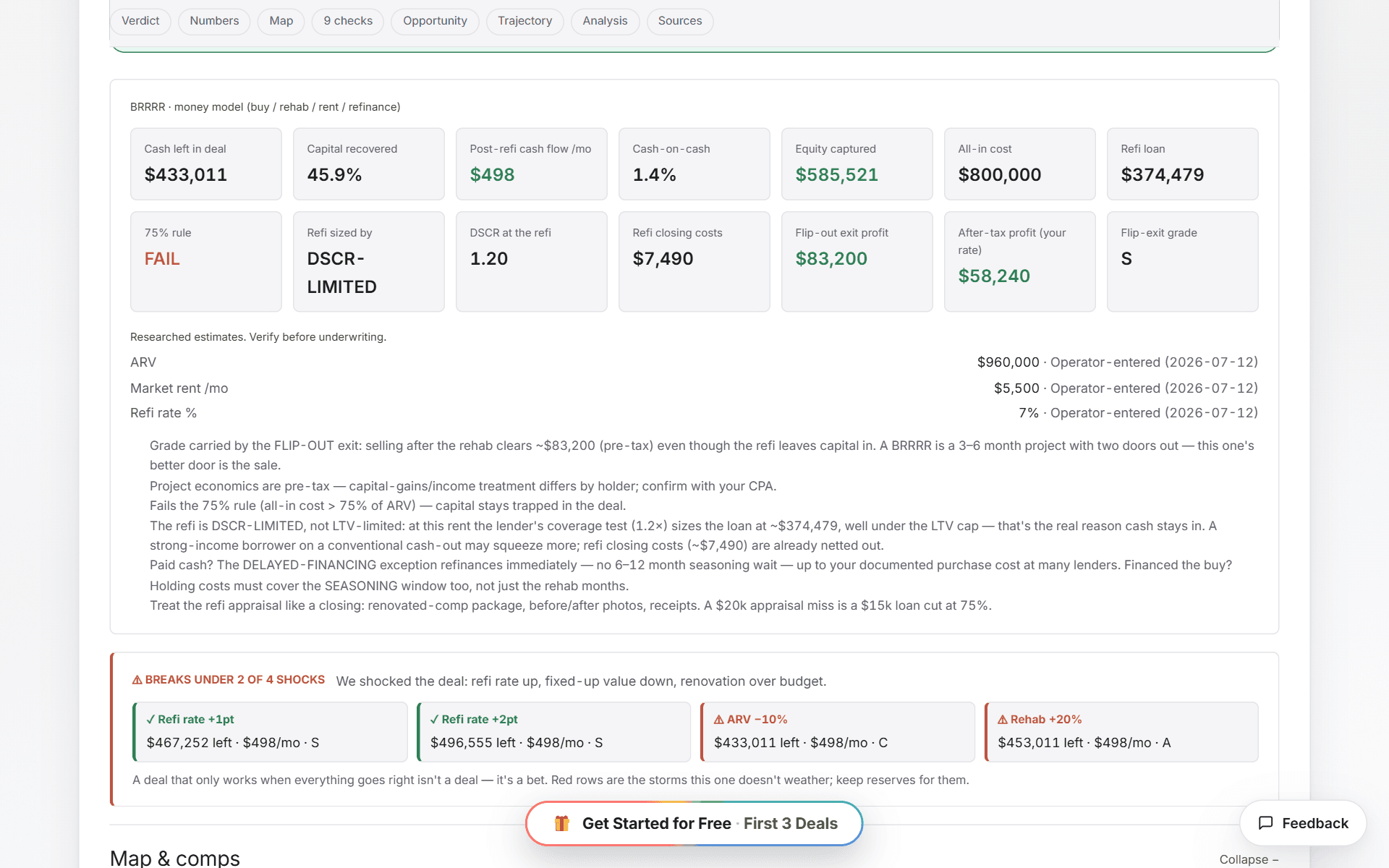
Capital recovered at the refi (sized the way lenders actually size it: LTV cap AND the rent coverage test), cash left in, cash flow after the refi, AND the exit where you sell instead, with its own grade. The better door carries the tier, and the verdict tells you which one did.
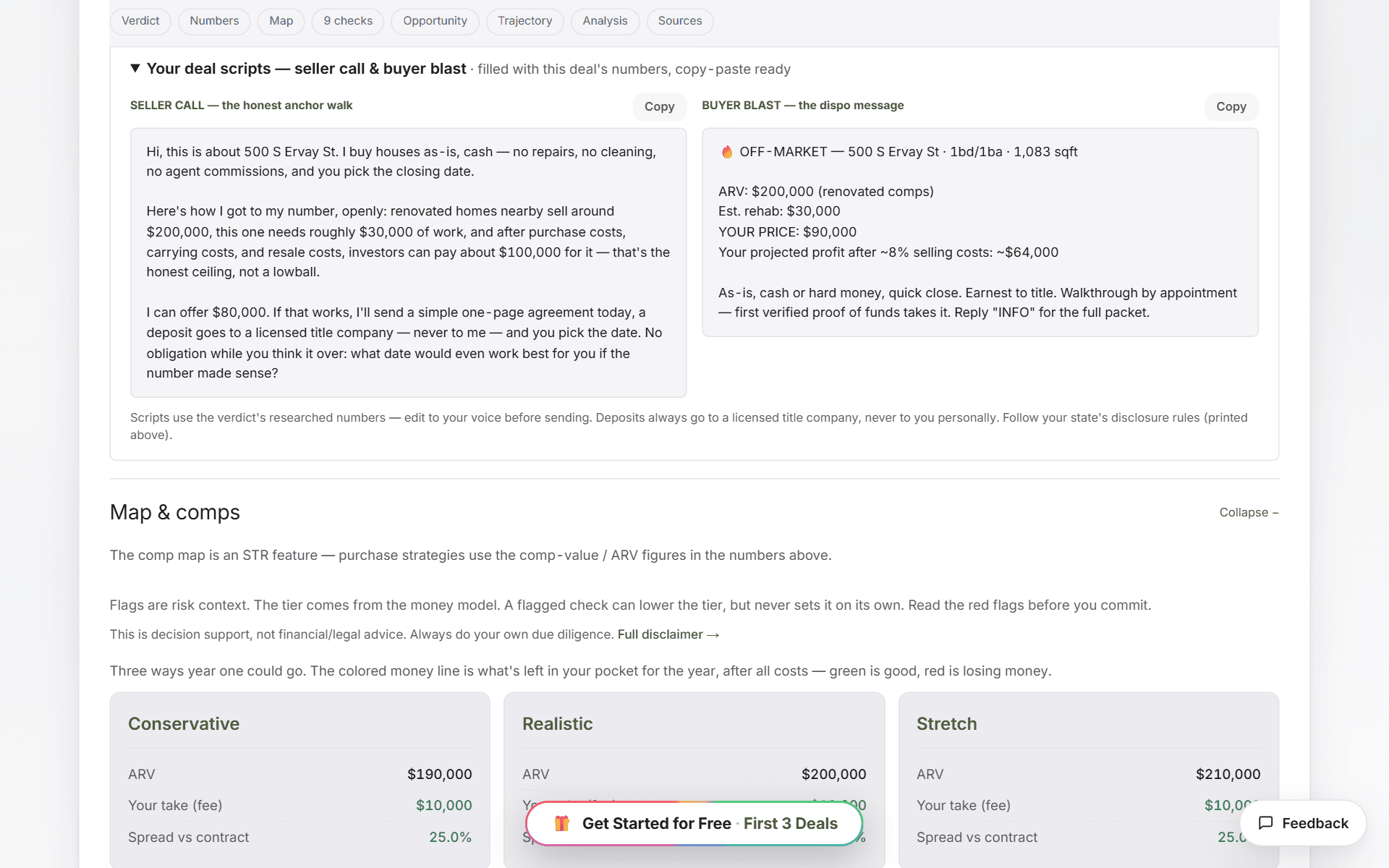
Every wholesale verdict writes your seller call (the honest anchor walk to your offer) and your buyer blast (with the end buyer's profit math), filled with the deal's researched numbers, ready to copy and paste.
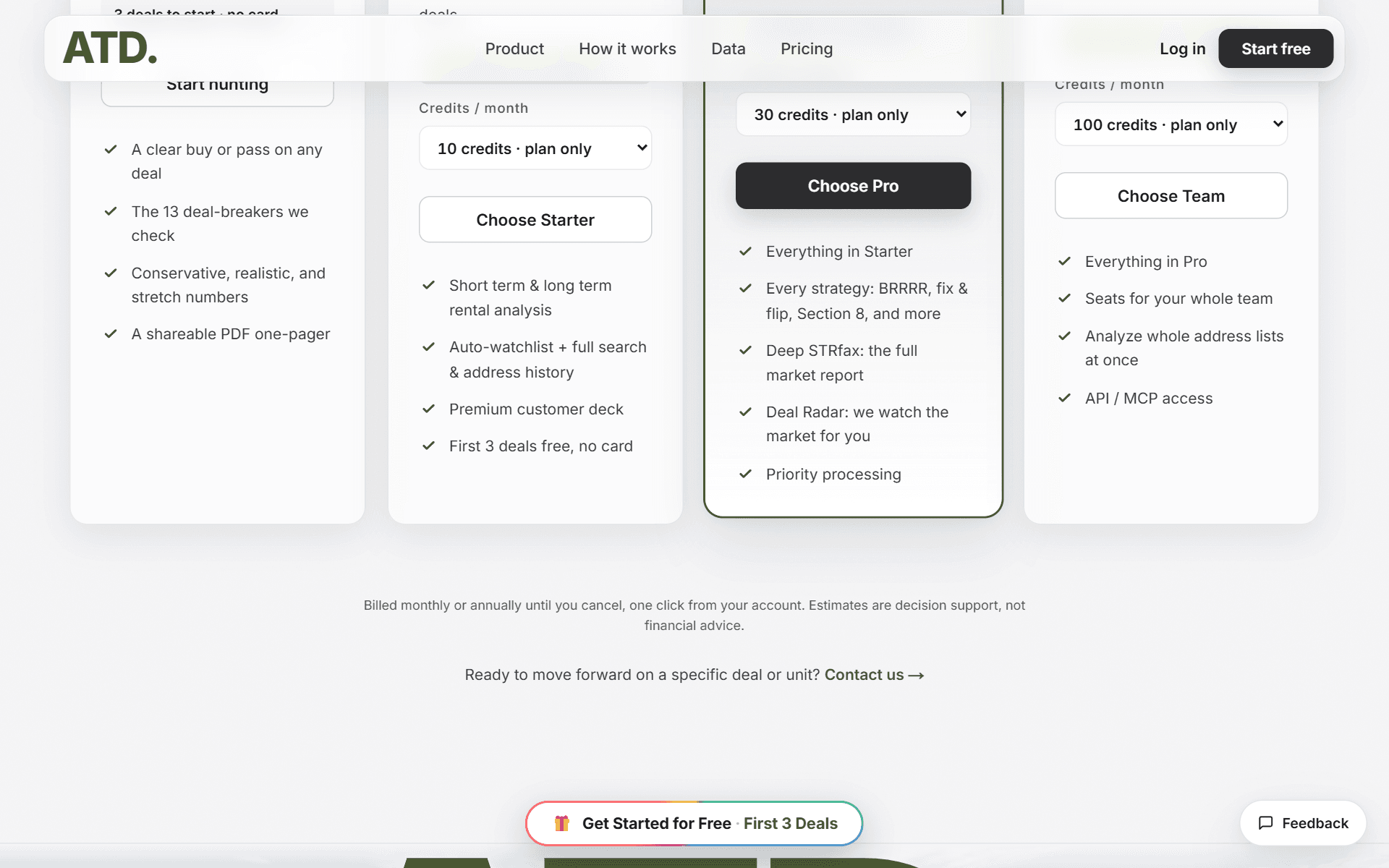
Tier = features; the credits dropdown = volume via real auto recharge packs. A standard run is 1 credit, a Deep run is 5. First 3 deals free, no card; cancel from your account in one click.
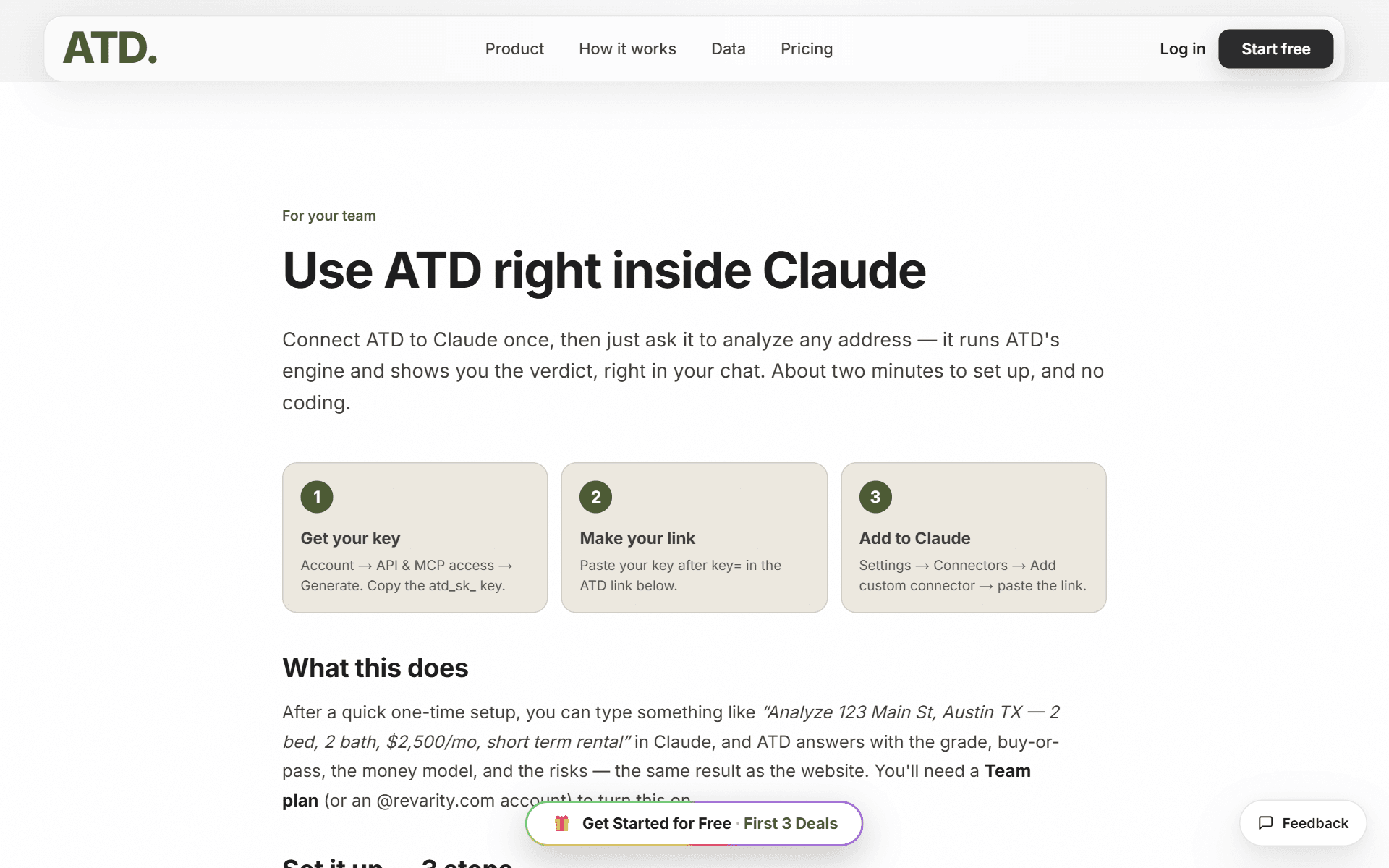
Team plan includes the MCP connector: paste one URL into Claude and run analyses, pull verdicts, and list strategies from chat. The setup page walks you through it in two minutes.
Everything else: the Q&A
Running deals
Which strategies can I analyze?
STR (short term rental), long term rental, Section 8, BRRRR, fix & flip (plus a straight buy value check), wholesale, subject to, and buy to live. Each is graded in its own units on its own horizon, never through another strategy's lens.
Can ATD read a listing link, PDF, or photos?
Yes: paste a listing URL or drop a PDF/screenshot on the intake and the assistant extracts what it can (address, beds/baths, price…). Big listing sites often block robots; when that happens we salvage what the link itself tells us and ask you to fill the rest.
What if I don't know a number, like the rate or taxes?
Leave it blank. Research fills it from live sources: today's mortgage rate for your location, the property tax AFTER THE SALE (many places reassess at your price), a new policy insurance quote reality. Anything still missing gets a labeled fallback with a prompt to enter the real figure.
Why did the same address grade differently under two strategies?
Because they measure different things: a flip is graded on project profit in months; a rental on monthly cash flow; a home on own vs rent across a decade. One address can be a strong flip and a weak rental at the same price.
Can I rerun with different numbers?
Yes. Adjust inputs on the results and update. Identical searches within 7 days reuse the prior result free. Changing money inputs (rent, price, down payment) recomputes instantly; changing the address triggers fresh research.
Reading your verdict
What do S, A, B, C, D actually mean?
A report card grade from the locked math: S = standout, move; A = strong, worth a call today; B = decent, negotiate; C = weak, needs a specific reason; D = the numbers don't work at this price. The verdict verb translates it: ACQUIRE, PILOT, or PASS.
Why does the check count change (13 vs 9 or 10)?
Each strategy runs only the checks that apply to it, and the count is computed from your actual run, so it can never overstate.
Can a risk check change my grade?
A flagged check can LOWER a tier, never set it on its own. The money model owns the grade. Red flags are context you read before you commit.
What's in the green and amber boxes?
Green = money on the table: government programs you may qualify for (help for first buyers, insured low down payment options, Section 8 landlord incentives) and the tax angles of your jurisdiction, US and Canada. Amber = the rules where the property lives: eviction timelines, rent control, deposit caps, licensing, special district fees. Know them before you buy.
Why does my verdict warn me about things I didn't ask about?
Because those are what burn people: rent reasonableness caps on Section 8, DSCR limited refis on BRRRR, FHA anti flip windows, vacant home insurance exclusions, pool upkeep in cold climates. The operator layer prices in what years in each trade teach.
Credits, plans & billing
What does a credit buy?
1 credit = a full research run (any strategy). 5 credits = a Deep run, which adds live comp validation: real listings, review themes, pricing rate cards, the regulatory dossier.
What's on the free tier?
3 full deals, no card, no time limit. Starter covers STR + long term; Pro unlocks every strategy, Deep runs, and Deal Radar; Team adds seats, bulk lists, and API/MCP access.
How do auto recharge packs work?
Pick your monthly credit volume on the pricing page. The dropdown adds a real recharge pack on top of the plan's included credits, billed together, adjustable or removable anytime.
Do unused credits roll over? Can I top up once?
Plan credits refresh monthly; one time top ups are available from your account page whenever you need a burst, with a volume bonus at larger sizes.
How do I cancel or get a refund?
Cancel from your account in one click. You keep access through the paid period. Something felt wrong with a run? Contact us; failed runs refund their credits automatically.
Is there a referral program?
Yes: your username keyed link gives a new signup bonus credits and credits you back on their first paid top up. Find your link on the account page.
Tools & power features
What is Market Watch?
Pro+ market intelligence: pick up to 5 cities and get daily trend signals built from persona level demand simulation (who actually travels/moves there month by month) plus news, policy, and platform signals. 1 credit per city scan.
What is Deal Radar?
Standing watchlists: tell ATD what you're hunting (city, strategy, numbers) and it flags matches for you instead of you searching again.
What can I download?
A PDF report of the deal and an Excel sheet of the numbers. The PDF is the full report once a deep report has run, and a one page report before that.
Can my team use ATD from Claude or the API?
Team plan includes MCP + API: one URL connects Claude (see /connect for the 2 minute setup), and API keys let you run analyses programmatically.
Troubleshooting
My link won't extract / says the site blocked it.
Big listing hosts wall off robots. We salvage the address from the link itself and continue. Fill any missing fields manually. Screenshots and PDFs of the listing extract more reliably than the link.
My run failed or hung.
Failed runs refund their credits automatically. Hit run again. An identical rerun within 7 days is free. Still stuck? Contact support with the address and rough time.
A researched fact looks wrong.
Tell us. Every figure carries its source, so it's fast to trace. Corrections improve the next thousand verdicts, and real questions get added to the Questions library.
Photos won't advance / the page looks off.
Hard refresh first (Ctrl/Cmd+Shift+R). Still broken? The Feedback button on any page reaches us with the context attached.
Metric glossary: every number, in plain English + its formula
Exactly how we get each number the tool shows you. The same math the engine runs, no black box.
Projected revenue / yr
What the unit grosses in a year before costs. It's the realistic case, not the best case. It's a projection off comparable listings, not a booking guarantee.
Formula: ADR × occupancy × 365 + cleaning-fee margin (realistic scenario)
Occupancy
The share of nights booked. We run it as a range across conservative / realistic / stretch. It's a range, not a promise. Realistic nudges the market rate up a few points and caps at 95%.
Formula: booked nights ÷ 365, from comp occupancy (realistic = market occ + boost, capped 95%)
ADR (avg nightly rate)
The average nightly rate you'd realistically clear. It's driven by what comparable units actually charge, not a wish. Realistic sits a notch above the comp median for a well-run listing.
Formula: comp median nightly rate × ~1.2 (realistic scenario)
Year-1 net
The real first-year profit after everything an operator actually pays. It's the number that decides the deal, not gross revenue.
Formula: annual gross + cleaning margin − OpEx (lease/effective rent, utilities, supplies, ~3% channel fees, insurance, ~0.5% maintenance, $500 mgmt)
Monthly net
Year-1 net spread over twelve months: what actually lands in the account each month on average.
Formula: Year-1 net ÷ 12
ROI (year 1)
First-year return on the cash it takes to open the doors: furnishing, deposits, first month, reno. Cash-on-cash, not appreciation.
Formula: Year-1 net ÷ cash-to-get-in × 100
Payback
How many months of net cash flow it takes to earn back everything you put in up front. Lower is safer.
Formula: cash-to-get-in ÷ monthly net (months)
Setup / cash-in
The all-in cash to get the unit live. It's the number people forget until it's due. Scales with bedroom count.
Formula: furnishing (by beds) + renovation + first month's rent + deposits
Grade / tier
Our one-glance grade of the deal, driven by monthly net. Then it can only get WORSE: a safety/pest or double risk-check FAIL knocks it a notch, and a weak-demand market caps it at C no matter how good the math looks. That downgrade discipline is the 10-year-operator part.
Formula: S ≥ $1,000 · A ≥ $750 · B ≥ $500 · C ≥ $250 · D below, on monthly net; − risk-check downgrade; demand-floor cap → C
Verdict
The buy/pass call in one word, straight off the tier. It's the decision, not homework.
Formula: ACQUIRE = S or A · PILOT = B · PASS = C or D
Cap rate
The unlevered yield: what the property earns as a share of its price, ignoring the mortgage. A quick cross-market yardstick for buy-and-hold.
Formula: net operating income (NOI) ÷ purchase price
Cash-on-cash
The levered cash return on the actual cash you invest. It's the number that matters once a loan is in the picture.
Formula: annual pre-tax cash flow ÷ total cash invested × 100
DSCR
Whether the rent covers the mortgage. Lenders live here. Below 1.0 the property doesn't cover its own debt.
Formula: net operating income (NOI) ÷ annual debt service (principal + interest)
Still stuck?
Email support@analyzethedeal.com or visit Contact. Real questions get answered, and the good ones get added to the Questions library.